
The Secret of Elegance in Casablanca Wines
The uniqueness of Chile's coastal wines is no coincidence; it is due to a flow of cold waters coming from the south: the Humboldt current. This current fulfills the vital mission of moderating temperatures, allowing varieties that love the cold to thrive in latitudes that would otherwise be unusually warm.
For the Chilean wine industry, this sub-Antarctic influence provides a differentiation that elevates the perception of quality in international markets, allowing Chile to compete in the exclusive global segment of premium cold climate wines.
The Casablanca Valley: Granite and sea breeze
Within the map of coastal valleys, the Casablanca Valley occupies a privileged place. Located about 24 kilometers from the sea, this valley is characterized by its soils rich in granite from the Coastal Range. These conditions are the ideal setting for the development of the two star varieties of our area: Chardonnay and Pinot Noir.
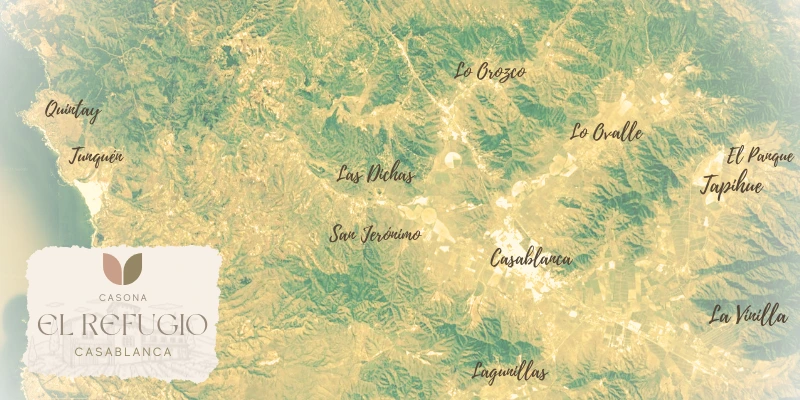
Thanks to the refreshing breeze that Humboldt pushes into our valleys, the grapes ripen slowly, preserving their acidity and developing complex aromas:
• Chardonnay: On the coast, this variety expresses itself with a notable elegance, showing a marked acidity and notes of green apple, fresh pear, and hints of lime.
• Pinot Noir: This grape, known for being delicate and sensitive to heat, finds its ideal environment in the coastal climate. The Pinot Noirs influenced by Humboldt usually have vibrant colors, silky textures, and characteristic aromas of cherry and damp earth.
Other coastal Valleys in Chile
The Valley of Limarí is also recognized for its clay soils, with vineyards located between 10 and 35 km from the coast.
Leyda and San Antonio are valleys closer to the ocean, where their main vineyards are only 13 km from the coast and receive significant maritime influence.
Further south we find vineyards on the coast near Colchagua and the Itata valley, and in the north we encounter Huasco. Each of these Valleys contributes its authenticity to the production of coastal wines influenced by the Humboldt current.
The next time you enjoy a glass at El Refugio, remember that you are savoring the legacy of a current that makes our valley a unique place in the world.